

The Evolution of Breast Implants: A 130-Year Journey from Stones to Silicone
Breast augmentation, one of the most prominent procedures in aesthetic surgery, possesses one of the most intriguing and educational narratives in medical history. Today’s modern silicone implants, chosen safely by millions of women, are the result of decades of trial and error, courageous surgeons, and advancing material science.
But how did modern medicine reach this point? Here is the hidden history of breast implants from 1895 to the present.
- The First Step: 1895 and Dr. Vincenz Czerny
The “father” of breast augmentation history, Dr. Vincenz Czerny, made a decision in 1895 in Germany that would change the medical world. For a patient who developed breast asymmetry due to a tumor, he removed a benign fatty tumor (lipoma) from the patient’s back and transplanted it into the breast cavity. This went down in history as the first recorded successful breast reconstruction.
- The Dark Era: Paraffin and Glass Beads
In the early 20th century, as surgeons searched for an answer to the question “What can we fill the breast with?”, they experimented with highly risky materials:
- Paraffin Injections (1899): While results initially seemed satisfying, they were quickly abandoned due to foreign body reactions and infections.
- Glass Beads and Ivory: Used in an attempt to provide shape, these rigid materials failed due to gravity and the resulting tissue damage.
- Sponges: Sponges tested for a soft feel eventually filled with body fluids and hardened, leading to the severe hardening problem known as “capsular contracture.”
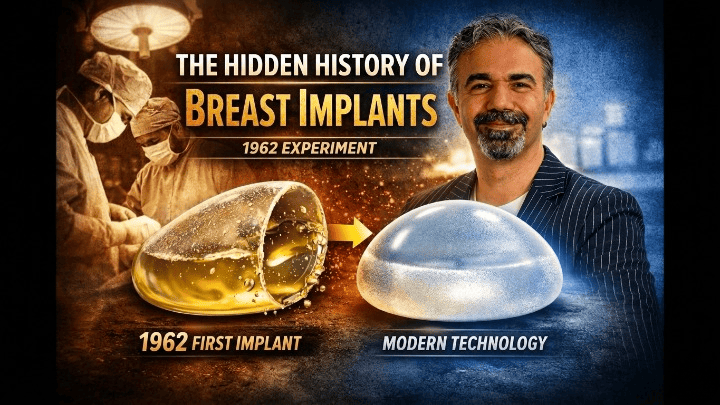
- 1962: The Birth of Modern Silicone and a Revolution
The true turning point in medical history occurred in Houston during the 1960s. Dr. Thomas Cronin and Dr. Frank Gerow discovered the biocompatibility of polymerized silicone.
- The First Subject: Initial trials of a gel encased in a silicone shell were conducted on a dog.
- The Historic Surgery: In 1962, Timmie Jean Lindsey became the first woman in the world to receive silicone breast implants. This event marked the beginning of the modern era in implant technology.
- Crisis and Exoneration: The 1990s and the FDA Ban
The 1990s are known as the “nightmare years” for silicone implants. Following a lawsuit where a patient attributed her breast cancer to the implants, silicone implants were banned in the United States for over 10 years. During this period, “Saline” implants containing salt water became prominent.
However, extensive scientific studies in the 2000s proved that silicone did not cause breast cancer, and silicone implants returned to the medical world fully “exonerated.”
- Present Day: Safety, BIA-ALCL, and New Technologies
The “cohesive gel” (form-stable) implants used today are significantly safer than previous generations.
- What is BIA-ALCL? In modern surgery, rare complications such as “Breast Implant-Associated Anaplastic Large Cell Lymphoma” (BIA-ALCL) are now meticulously monitored. Occurring at a very low rate—cited in some literature as 3 in 500,000—this condition is treatable with early diagnosis.
- New Protocols: Early post-operative massage is no longer recommended, and regular annual ultrasound screenings are advised.
Conclusion: The Unending Evolution of Medicine
Breast augmentation is the clearest example of how medical history perfects itself by learning from its mistakes. An 85-year chain of complications now allows surgeons to perform operations with a near-zero margin of error. Medicine is not perfect, but it is in a state of constant evolution, and today we are at its safest stage yet.