
Rhinoplasty is the surgical reshaping of the cartilage and bones of the nose. The aim is not only to change its appearance but also to preserve, and if necessary improve, breathing and the sense of smell. The goal is not to make the nose smaller or larger, but to achieve a nose that is in harmony with your face and suits you.
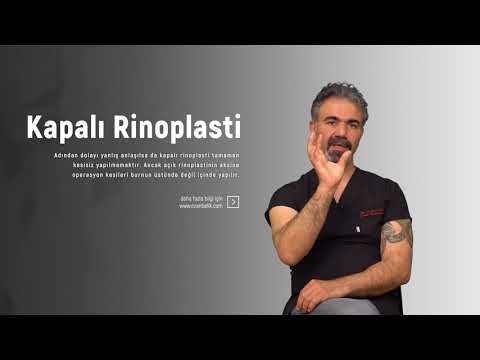
At our clinic, rhinoplasty is performed using the closed technique. Breathing problems such as a deviated septum, enlarged turbinates and sinusitis can be treated in the same operation.
At a glance
- Duration of surgery: 1.5 hours on average (longer if sinus surgery, revision or harvesting of ear/rib cartilage is needed).
- Anaesthesia: General anaesthesia.
- Hospital stay: Usually 1 night.
- Nasal packing: Usually not needed; short silicone splints are placed inside the nose and removed together with the cast at the end of week 1.
- On the nose: A cast (splint); after it is removed, thin tape. Duration: 7 days.
- Return to desk work: About 3–4 days. Return to work that involves face-to-face contact with people: about 10–20 days.
- Strenuous exercise: After a few months.
- Swelling: Decreases noticeably by the end of the first month; the final result usually takes 6 months–1 year, longer with thick skin.
- Follow-up: Close follow-up in the first week. Later check-ups: at months 1, 3, 6 and 12.
- Stay in Istanbul if you are coming from another city or from abroad: 7 nights after surgery
These figures are averages and vary from person to person. Your personal plan is prepared at the consultation.
Who is it suitable for?
| Situation | Example |
|---|---|
| Dissatisfaction with appearance | A hump, a drooping, upturned, pointed or bulbous-looking tip, a wide or crooked nose. |
| Deformities after injury | Crookedness after a blow or fracture. |
| Congenital deformities | Asymmetry and differences in shape present from birth. |
| Breathing difficulty | Deviated septum, enlarged turbinates, sinusitis. |
Age limit
In rhinoplasty, what matters more than age is that the nasal bones and cartilage have finished developing. For this reason, 17 for girls and 18 for boys is generally accepted as the lower limit. There is no upper age limit; however, because the risk of anaesthesia increases with age, your general health is assessed separately.
It is important that your general health is suitable for surgery and that your expectations are realistic. In people who focus excessively on very small differences in their nose or who expect a flawless result, the decision to operate is made with care.
How is rhinoplasty performed?
Closed and open technique
| Closed technique | Open technique | |
|---|---|---|
| Incision | All incisions are inside the nose. | In addition to the incisions inside the nose, a small incision on the bridge between the two nostrils (columella). |
| External scar | No visible scar remains on the outside. | A fine scar on the columella; it usually fades over time. |
| At our clinic | This is the method used. | — |
In patients whose nostrils need to be narrowed, small incisions may be needed in the crease where the nostril meets the face; these incisions may leave a small visible scar. However, because these scars sit along the natural fold of the nostril, they usually go unnoticed.
What is done to the nasal bones?
The nasal bones are not broken at random. When necessary, they are filed down or cut in a controlled way through small incisions made inside the nose. This allows the bone structure to be brought into the desired shape.
Hump and nasal tip
A hump on the bridge of the nose is corrected by removing excess cartilage and bone. A drooping, upturned, pointed or bulbous-looking tip is reshaped; the tip is not touched unless it is causing a problem.
Cartilage support
When the structure of the nose needs support or missing cartilage needs to be replaced, ear or rib cartilage can be used. In this case the operation takes longer. This support is needed more often, especially in patients who have had previous surgery and have less cartilage left inside the nose.
Breathing problems and the inside of the nose
During rhinoplasty, problems such as a deviated septum, enlarged turbinates and sinusitis can also be treated in the same operation. If you have breathing complaints before surgery, be sure to mention them; they are assessed by examining the inside of the nose and, if necessary, with imaging.
Tip-only rhinoplasty
For people with no problem on the bridge of the nose, whose only complaint is a drooping, wide or bulbous-looking tip, an operation targeting only the tip can be planned. In this case the bones are not touched; the recovery and swelling are usually more limited.
How does skin thickness affect the result?
In people with thick skin, it may take longer than 1 year for the skin to settle onto the new nasal structure. Thick skin can limit how visible fine details of the tip are from the outside, and swelling lasts longer. With thin skin, the result becomes apparent sooner; however, small irregularities in the underlying cartilage and bone may also be noticed more easily. For this reason, planning is based on your skin type.
Harmony between the nose and the face
How the nose looks depends not only on the nose itself but also on the other parts of the face. For example, a receding chin can make the nose look larger than it is. For this reason, the profile view of the face is also assessed at the consultation; if needed, procedures for areas such as the chin are also discussed.
Simulation
Before surgery, an estimated result is shown using a computer program. Photographs are taken with a ruler and printed at actual size. The simulation gives you a general idea; however, it is not the exact result, and the actual planning is based on the examination findings. Sample photos of noses you bring are not copied exactly either; your doctor determines what suits your face.
What happens on the day of surgery?
Rhinoplasty is performed in a fully equipped hospital under general anaesthesia; local anaesthesia is not considered suitable for this operation. The operation takes 1.5 hours on average. Usually no packing is placed inside the nose; short silicone splints are used instead. If extensive work was done inside the nose, packing may be needed. A cast is placed on the nose, and you usually stay in hospital for 1 night.
On the first night after surgery, a blocked nose and a feeling of pressure are normal; pain is usually controlled with painkillers. Sleeping with your head raised and applying cold intermittently help reduce swelling.
Preparing for surgery
Tell us at the consultation about all the medicines you take (including blood thinners), herbal supplements and any chronic illnesses; whether, when and how to pause a medicine is decided together with the doctor who prescribed it. Do not stop any medicine on your own. Because general anaesthesia will be used, follow the personal instructions the anaesthesia team gives you on how long to fast. Since smoking has a negative effect on healing and on the blood supply to the skin of the nose, it is recommended that you stop before and after surgery.
On the day of surgery, come without make-up and do not wear contact lenses. Wearing a top that buttons or zips at the front makes it easier to protect your nose when changing clothes after surgery.
Questions you can ask at the consultation
What changes will be made to my nose? Can my breathing problem be solved in the same operation? Will I need cartilage support? Will packing be used? How long will the cast stay on? When will the result settle? When can I return to work?
The first week, day by day
| Day | What to expect |
|---|---|
| Day 1 | Observation in hospital. A blocked nose and a feeling of pressure are normal; you breathe through your mouth. Swelling and bruising around the eyes may begin. |
| Days 2–3 | Swelling and bruising are usually at their most noticeable. Sleeping with your head raised and applying cold bring relief. |
| Days 3–4 | You can return to desk work. |
| Days 4–7 | Swelling and bruising begin to subside. Close follow-up by the doctor continues throughout the first week. |
| End of week 1 | The silicone splints and the cast are removed. |
Timelines vary from person to person; your personal schedule is given at your check-ups.
Recovery after surgery
| Period | What to expect |
|---|---|
| First night | You usually stay in hospital. |
| First week | Close follow-up by the doctor. There is a cast on the nose. |
| Days 3–4 | You can return to desk work. |
| Day 7 | The silicone splints and the cast are removed; thin tape is applied. |
| Days 10–20 | You can return to work that involves face-to-face contact with people. |
| End of month 1 | Swelling decreases noticeably. |
| After a few months | You can return to strenuous exercise. |
| 6 months – 1 year | The nose takes on its final shape. In people with thick skin, it may take longer than 1 year for the skin to settle. |
What to watch out for in daily life
It is recommended that you protect your nose from knocks and pressure and avoid direct sunlight. Because heavy glasses can press on the bridge of the nose in the first weeks, you will be told at a check-up when you can wear them. Avoid blowing your nose hard, very hot environments, and the sea and swimming pools until your doctor allows it. Air travel is usually possible once the first check-ups have been completed.
Risks
As with any surgical procedure, rhinoplasty has risks. These risks are discussed with you in detail at the consultation.
| Risk | Explanation |
|---|---|
| Bleeding inside the nose | Usually stops on its own; if necessary, it is stopped with packing. |
| Breathing difficulty | There may be difficulty breathing after surgery. |
| Adhesions inside the nose | Adhesions may develop at the septum. |
| Numbness around the nose | Usually temporary; rarely, it may be permanent. |
| Asymmetry | Differences between the two sides may remain. |
| Discolouration, persistent swelling | May occur. |
| Scarring | Especially in cases that require an external incision. |
| Need for further surgery | A correction may be needed if you are not satisfied with the result or because of functional problems. |
| Infection, anaesthesia-related risks | Rare. |
If after surgery you have a nosebleed that does not stop, fever, severe pain and swelling inside the nose, marked difficulty breathing or a change in your vision, contact the clinic or the nearest emergency department without delay.
Revision (secondary) rhinoplasty
A corrective operation can be performed for people who have had rhinoplasty before and are not satisfied with the result or have breathing problems. To allow the tissues to heal fully and the swelling to subside, it is usually recommended to wait at least 1 year after the first operation. Revision operations are more complex than the first operation; because the cartilage inside the nose may have been reduced, ear or rib cartilage may be needed and the operation takes longer.
Rhinoplasty in men
The lower age limit for rhinoplasty in men is usually 18. In men, the bridge of the nose is usually planned to be straighter, the tip less upturned and the nose stronger in structure; the aim is a result in harmony with masculine facial features. Because men's skin is often thicker, it may take longer for the swelling to subside and for the nose to take on its final shape.
Non-surgical rhinoplasty (filler)
In non-surgical rhinoplasty, filler is used. This method is preferred for minor asymmetries and irregularities in shape, provided the structure of the nose is suitable. Filler does not make the nose smaller, does not remove a hump and does not correct breathing problems; its effect is temporary. Because the nasal area is delicate due to its blood vessel structure, filler should only be applied by an experienced doctor.
If you are coming from abroad or from another city
It is recommended that you stay under the doctor's supervision for the first week. For this reason, it is recommended that you plan your stay in Istanbul and your return so that you can at least complete the removal of the cast and the first check-up. How your follow-up will continue after you return home is explained to you before surgery.
Videos


Frequently Asked Questions
Who performs rhinoplasty?
Rhinoplasty can be performed by a plastic surgeon or by an ear, nose and throat (ENT) specialist.
How long does the operation take?
It takes 1.5 hours on average. If sinus surgery, revision or harvesting of cartilage is needed, it takes longer.
Are the nasal bones broken?
No, they are not broken at random. When necessary, they are filed down or cut in a controlled way through small incisions inside the nose.
Is nasal packing used?
Usually not. Short silicone splints are used, and removing them is not painful. If extensive work was done inside the nose, packing may be needed.
Can it be done under local anaesthesia?
No. General anaesthesia is the most suitable for rhinoplasty, and it should be performed in a fully equipped hospital.
When can I return to work?
You can return to desk work after about 3–4 days, and to work that involves face-to-face contact with people after about 10–20 days.
When will my nose take on its final shape?
Swelling decreases noticeably by the end of the first month; the nose usually takes on its final shape between 6 months and 1 year. In people with thick skin, this can take longer than 1 year.
Does rhinoplasty affect breathing?
Rhinoplasty aims to preserve breathing function; if there are problems such as a deviated septum or enlarged turbinates, they can be corrected in the same operation. Breathing difficulty is also among the possible risks.
Can I bring a photo of a nose I like?
Yes, you can; however, the sample photo is not copied exactly. Your doctor determines what suits your face.
At what age can it be done?
Usually from age 17 for girls and 18 for boys; what matters is that bone and cartilage development is complete.
Can it be combined with prominent ear correction?
Yes. Prominent ear surgery (otoplasty) is often performed together with rhinoplasty.
Is rhinoplasty covered by SGK?
Our clinic does not work with the Turkish Social Security Institution (SGK); operations and treatments are not covered by SGK.
What determines the price of rhinoplasty?
The price is determined after the consultation. The hospital where the operation is performed and the doctor's experience affect the price. Whether it is a first operation or a revision, additional procedures for breathing problems and whether cartilage needs to be harvested also affect the plan and the cost. You can contact our clinic for price information.
Rhinoplasty assessment with Assoc. Prof. Dr. Ozan Balık
At the consultation, the external structure of your nose, the inside of your nose, your breathing, your skin thickness and your facial proportions are assessed. The possible result is discussed together using a simulation; the technique to be used, whether cartilage support is needed, recovery and follow-up are explained in detail.
What should you look for when choosing a surgeon for rhinoplasty?
Find out whether the doctor who will perform the operation is a specialist in Plastic, Reconstructive and Aesthetic Surgery, and who carries out the consultation. Ask about the licence of the healthcare facility where the operation will take place, who will administer the anaesthesia, and whom you can reach in an emergency after surgery. Consider the reasons for the proposed plan, its risks and alternatives together with written information.
For patients coming from abroad, it is important whether the healthcare facility holds an International Health Tourism Authorisation Certificate. Our clinic's authorisation certificate number is ST-1352.
What can you share when contacting us?
It is enough to tell us that you would like information about rhinoplasty and to give us contact details where you can be reached. You can book your consultation online or send your question directly to Assoc. Prof. Dr. Ozan Balık. General information given by message does not replace a consultation or a definitive surgical plan.
Contact us for price information.
Medically reviewed by Assoc. Prof. Dr. Ozan Balık. Last updated: 8 November 2026
The information on this page is for general information only; always consult your doctor for diagnosis and treatment.